

Idroponica Facile Guide to home growing with hydroponic towers
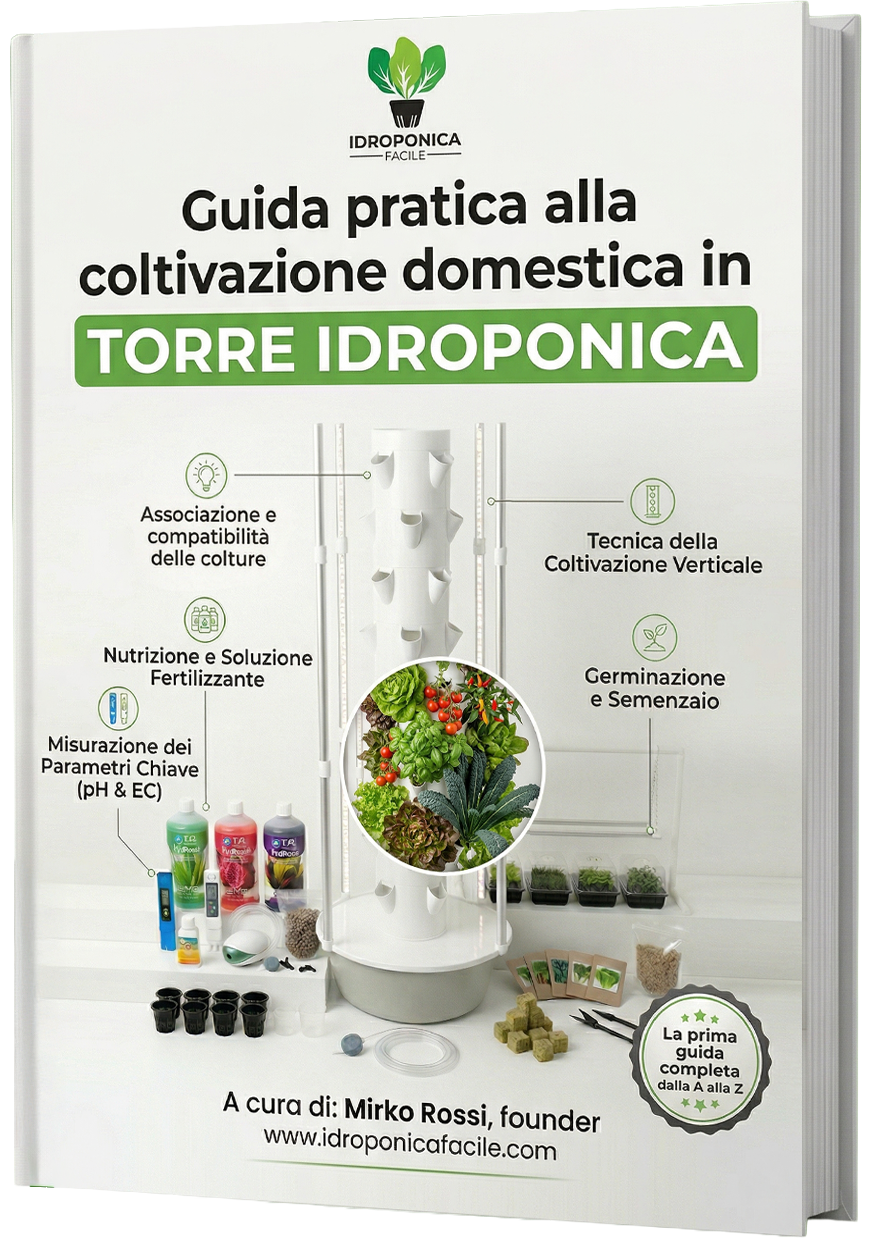 The first complete practical guide in Italian, from A to Z: from sowing to harvest, from nutrient solution to problem management. Everything you need, nothing more.
Everything you'll find in the guide
Not a collection of generic tips: each chapter addresses a specific moment in the growing journey, in the exact order you'll experience it.
The only theory you need
pH, EC, light, temperature and relative humidity. Five concepts explained practically: only what you need to make the right decisions every day, without unnecessary technicalities.
Defining your goals
How to choose the right vegetables for your tower, and why pairing plants with the same light, nutrition and temperature requirements makes the difference between a mediocre harvest and an exceptional one.
Idroponica Facile equipment
A detailed description of every component of the tower, the growing kit and the germination kit: reservoir, modules, pump, LED bars, measuring pens, TriPart, expanded clay and everything else.
The seedling tray: sowing and transplanting
Pre-sowing, sowing step by step, dome management, irrigation from germination to true leaves, through to transplanting into the tower with roots ready. The most delicate phase, explained in detail.
Tower assembly and preparation
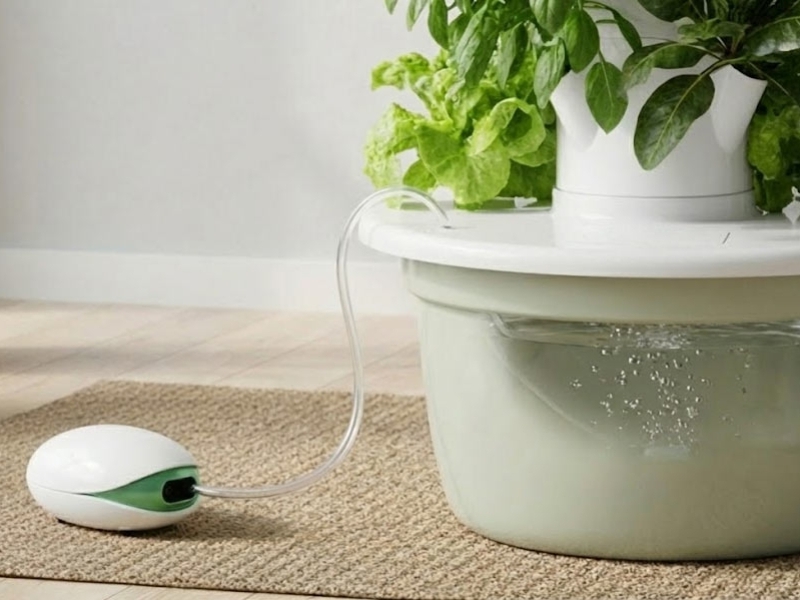
Complete assembly instructions: from the reservoir to the modules, from the pump to the LED bars, through to connecting the oxygenator for complete kits. All you need is a Phillips screwdriver and this guide.
The nutrient solution and start-up
How to choose the right TriPart formulation for your tower, the correct mixing order, pH correction and the first filling of the reservoir. With optimal formulas for both leaf and fruiting towers.
Routine checks
What to check, when and how. The routine that minimises errors: a quick check every 2–3 days, a more thorough one once a week. EC, pH, water level, corrective top-ups.
Staggered harvest and production cycle
How to harvest without stressing the plants, when to do a full head harvest, the cut-and-come-again method for rocket and mizuna, and how to manage a slot once freed after each removal.
Rotation sowing
The Infinite Harvest formula: sow every 2 weeks at 25% of the tower's capacity, with the right balance between fast and slow-growing plants. The method to always keep the tower full with something ready to harvest.
Full harvest and reset
When and how to empty the tower completely to start afresh: situations where it makes sense, the step-by-step procedure, and how to restart in the right way.
Periodic maintenance
Routine maintenance every 2–3 days, solution change every 4–6 weeks, full clean at the end of each cycle. What needs doing — and what doesn't.
Plant and tower signals
How to read what your plants are telling you: seeds that won't germinate, pale leaves, slow growth, burnt tips, brown roots, unusual pump noise, reduced flow. Causes and solutions.
The most common mistakes
Over 30 mistakes catalogued by category — approach, nutrients, pH, light, seedling tray, water, oxygenation, maintenance — with an explanation of what to do instead. Including the "mistakes" that actually aren't.
Your first 30 days
A day-by-day timeline: from day 0 (pre-sowing) to day 30+ (first harvest). A clear roadmap to guide you through the first few weeks without missing a single step.
Reference tables
pH and EC table for 24 vegetables and herbs, ordered by increasing nutritional requirement. Recommended seeds per cube table. The quick reference to consult whenever you need it.
The theory you actually need (nothing more)
In hydroponics, there are five parameters that matter. Keep them under control, and everything else manages itself.
pH and EC for the most common vegetables
Recommended values for hydroponic tower growing, ordered by increasing nutritional requirement. The complete table is in the guide.
| Vegetable / Herb | EC min–max (mS/cm) | Recommended pH |
|---|---|---|
| Lamb's Lettuce / Corn Salad | 0.8 – 1.2 | 6.0 – 7.0 |
| Cut Lettuces | 0.8 – 1.6 | 5.8 – 6.2 |
| Rosemary | 0.8 – 1.6 | 5.5 – 6.5 |
| Thyme | 0.8 – 1.6 | 5.5 – 6.5 |
| Basil | 1.0 – 2.0 | 5.8 – 6.2 |
| Rocket | 1.0 – 2.0 | 5.8 – 6.2 |
| Parsley | 1.0 – 2.0 | 5.8 – 6.2 |
| Head Lettuces | 1.2 – 1.8 | 5.8 – 6.2 |
| Mizuna | 1.2 – 2.0 | 5.8 – 6.2 |
| Endive / Escarole | 1.5 – 2.0 | 5.8 – 6.2 |
| Spring Onions | 1.5 – 2.5 | 6.0 – 7.0 |
| Pak Choi | 1.5 – 2.5 | 6.0 – 7.0 |
| Spinach | 1.8 – 2.3 | 6.0 – 7.0 |
| Chard | 1.8 – 2.3 | 6.0 – 7.0 |
| Celery | 1.8 – 2.4 | 6.0 – 6.5 |
| Mint | 1.8 – 2.4 | 5.8 – 6.2 |
| Peppers | 2.0 – 3.0 | 5.8 – 6.2 |
| Cavolo Nero | 2.0 – 3.0 | 6.0 – 7.0 |
| Curly Kale | 2.0 – 3.0 | 6.0 – 7.0 |
| Cherry Tomatoes | 2.0 – 3.5 | 5.8 – 6.2 |
→ The complete table with all vegetables is in the guide, Appendix B.
Your first 30 days, step by step
A chronological roadmap so you don't miss any step in the first few weeks. Timings are approximate and vary depending on the species grown.
-
Day 0
Pre-sowing
Prepare rested water, correct pH to 5.8–6.0 and soak the rockwool cubes for 6–24 hours.
-
Day 1
Sowing
Place the seeds in the cubes, cover with vermiculite, close the trays with the dome, switch on the seedling LED lights.
-
Days 2–5
Germination
Check daily: remove the dome for 10 minutes to air, keep the cubes moist but not waterlogged.
-
Days 5–10
Cotyledons
The first two seed leaves appear. Open the dome vents. Prepare a light nutrient solution (EC 0.6).
-
Days 10–18
First true leaves + tower assembly
Remove the dome, begin feeding the seedlings. Meanwhile, assemble the tower and prepare the nutrient solution.
-
Days 18–22
Transplanting
3–4 true leaves and roots protruding by 3+ cm: the time is right. Insert the seedlings into the tower and start the system.
-
Days 22–30
Growth in tower
Check EC and pH every 2–3 days, monitor the water level. A slight loss of vigour after transplanting is normal.
-
Day 30+
First harvest 🌿
Begin the staggered harvest of outer leaves. Sow the next batch to maintain continuous rotation.
The questions we're asked most often
Direct answers to the most common questions about home hydroponics. All covered in depth in Chapter 14 of the guide.
Everything you need, in a single kit
The guide is written for Idroponica Facile systems, but the principles apply to any hydroponic tower. If you want to start with everything already included, these are the recommended kits.
Complete Kits
All Idroponica Facile kits: choose the system that best suits your needs and start growing straight away.
View all kitsGreen Leaf Tower
The ideal tower for lettuces, rocket, spinach, herbs and leafy vegetables. White LED bars, 36 growing positions, complete system.
PERFECT FOR BEGINNERS
Fruiting Tower
For cherry tomatoes, peppers, cavolo nero and fruiting vegetables. Full-spectrum LED, support structure included, maximum yield.
Discover the towerOutdoor Tower
36 growing positions powered by natural sunlight. Zero energy consumption, perfect for balcony, terrace or garden.
Discover the towerGermination Kit / Seedling Tray
The starting point: germinate your seeds in optimal conditions before transferring them to the tower. With LED lights dedicated to the sowing phase.
Discover the kitGrowing Kit
Everything you need to set up and manage your tower: measuring pens, TriPart, expanded clay and accessories included.
Discover the kitNutrients
The TriPart system (Micro, Grow, Bloom) by Terra Aquatica / GHE used in this guide. Available for soft and hard water.
Discover the nutrientsReady to get started?
Download the guide, read it at your own pace, then come back here to choose the right kit for you. Growing at home can be truly easy.
↓ Download the free guide (PDF)