

The Vertical Scenography: Domestic Hydroponic Towers as Living Sculptures
- Vertical Scenography: Domestic Hydroponic Towers as Living Sculptures in Contemporary Design
- I. Introduction: Beyond Agriculture, Inside Architecture
- The Paradox of the Tool Becomes a Style Object
- The Purpose of Design: Harmony Between Form and Function
- II. The Triumph of Residential Biophilia: Connecting Space and Nature
- The Biophilic Imperative: From Architecture to the Domestic Microcosm
- The Aesthetic Function of Dynamic Greenery
- III. The Hydroponic Tower as a Sculptural “Focal Point”
- Visual Anchoring and Functional Sculpture
- Modularity for Aesthetic Customization
- IV. Design Anatomy: Technical Integration Without Aesthetic Compromise (Clean Design)
- The Aesthetics of Hidden Function: The Art of Concealment
- Materials, Hygiene, and Perceived Sustainability
- V. Lighting: Functional Light Scenography for Domestic Habitats
- The Full Spectrum Solution: Goodbye Purple Light
- Discreet Integration and Nighttime Scenography
- VI. Summary of Key Points and Professional Validation
- VII. Conclusions and Invitation
Vertical Scenography: Domestic Hydroponic Towers as Living Sculptures in Contemporary Design
I. Introduction: Beyond Agriculture, Inside Architecture
The evolution of home cultivation has triggered a profound transformation in how we perceive and integrate green technology into modern living spaces. The domestic hydroponic tower, in particular, has evolved from being a mere agricultural tool into a sophisticated design element that intersects high technology, sustainability, and cutting-edge aesthetics. It is no longer about assembling rudimentary setups—often associated with visible PVC piping—but about introducing a manifesto of intentional design that asserts an active and primary role in interior decoration.
The Paradox of the Tool Becomes a Style Object
Contemporary hydroponic systems are designed to transcend purely utilitarian aesthetics. To be integrated into high-end residential contexts or minimalist spaces, they must necessarily adopt design principles that elevate them to luxury objects, comparable to high-end appliances or designer lamps. The key to this aesthetic success lies in the ability to balance complex functionality (nutrition, irrigation, lighting) with impeccable visual cleanliness. Analysis from designers and architects confirms that the hydroponic tower is not just a growth structure, but a true statement piece.
The Purpose of Design: Harmony Between Form and Function
The primary challenge faced by designers of these solutions is not merely ensuring optimal plant growth, but concealing technological complexity. Essential components such as nutrient tanks, water pumps, and control systems must be integrated so that their presence does not compromise the harmony of the living space. The aesthetic value of the hydroponic tower is analyzed through three main lenses: biophilic integration, structural modularity, and luminous scenography—elements that together define its legitimacy within contemporary design.
II. The Triumph of Residential Biophilia: Connecting Space and Nature
Biophilic design, defined as the practice of connecting building occupants with the surrounding natural environment (directly or indirectly), provides the strongest theoretical foundation for integrating hydroponic towers into interior spaces.
The Biophilic Imperative: From Architecture to the Domestic Microcosm
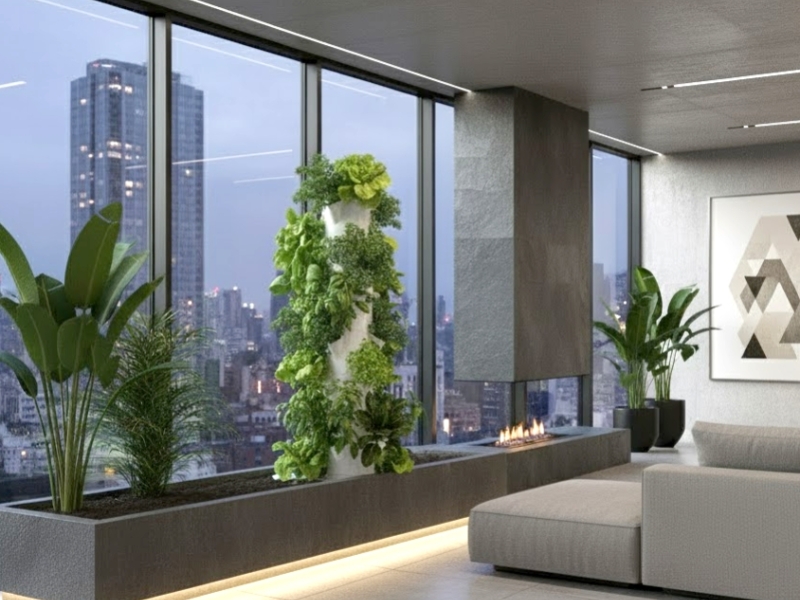
The principle of Biophilia is widely validated in modern architecture, as demonstrated by large-scale projects such as Stefano Boeri’s Bosco Verticale or works by studios that integrate vertical green façades, such as Mino Caggiula Architects. Domestic hydroponic towers represent the miniaturization of this vision, addressing the fundamental need to transform the home into a “natural refuge.”
The introduction of natural elements significantly contributes to overall well-being, offering “positive sensory stimulation” through colors, textures, and organic forms that enrich spatial experience and make it more “memorable.”
The Aesthetic Function of Dynamic Greenery
Hydroponics guarantees lush, living greenery—an intrinsic aesthetic value that is essential. Plants grown in hydroponic systems are particularly valued in these contexts because they maintain a “healthy appearance without the need for complex maintenance” typical of soil-based cultivation, ensuring a constant visual impact free from aesthetic stress related to decay.
Moreover, the hydroponic tower elegantly addresses the challenges of urban living. In high-density cities where space is limited (apartments, lofts), vertical gardens and towers provide “a vibrant addition” that does not take away precious square footage. Nature is not a bulky guest but a compact, vertical furnishing element.
A crucial aspect for design- and ethics-conscious consumers is that the hydroponic tower acts as a tangible symbol of sustainable practices. The system is not merely a passive biophilic element but a visible and active indicator of resource efficiency (for instance, using significantly less water than traditional systems). The lush greenery, ensured by hydroponic efficiency, visually translates into an aesthetic of ecological success, subtly reflecting the owner’s ethical values.
III. The Hydroponic Tower as a Sculptural “Focal Point”
In high-end interior design, defining a focal point is vital for the visual organization of a room, being “the first thing viewers see when they enter” and the element that creates a “statement.”
Visual Anchoring and Functional Sculpture
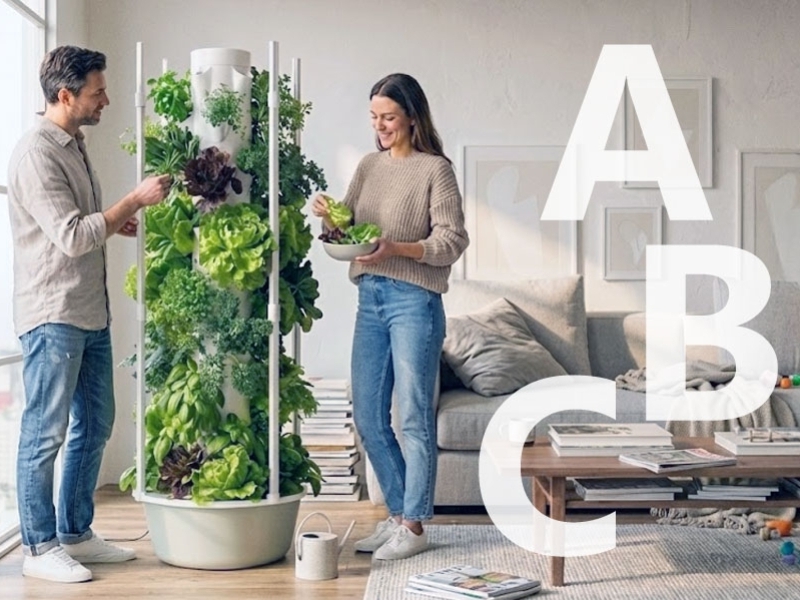
The hydroponic tower, thanks to its vertical structure, height, and concentration of living vegetation, naturally assumes the role of focal point. Designers often use “sculptural furniture” to anchor the gaze, and the tower perfectly fits this definition, merging functionality (food or herb production) with the artistic expression of its structure and the lush greenery it hosts.
Models that combine advanced technology with clean lines—such as the systems offered by Idroponica Facile—are well received precisely for their balanced design, being described as “very pleasing to look at.” The ability to host a large number of plants (up to 36 in Idroponica Facile’s case) further amplifies its presence, making it an unmissable feature.
Modularity for Aesthetic Customization
A fundamental requirement for personalized integration into designed environments is flexibility. Hydroponic towers are often conceived as modular or composable systems. For example, thanks to Idroponica Facile’s diverse offerings, height and footprint can be adjusted. This control over form and scale turns the system into a bespoke piece, essential for harmonious adaptation to existing architecture.
Unlike a static decorative vase, the hydroponic tower introduces an element of aesthetic performance. The continuous growth and vitality of the plants represent not just dynamism but a visual evolution that reflects the success of the system itself. This element of vitality—ensured by optimal functional efficiency—transforms the tower into an object that tells a story of efficiency and abundance, an impeccable stage where life unfolds in a refined architectural context.
IV. Design Anatomy: Technical Integration Without Aesthetic Compromise (Clean Design)
The hallmark of high-quality design—especially in systems combining water, electricity, and plant growth—is the ability to encapsulate technology, making the mechanisms operating in the background invisible.
The Aesthetics of Hidden Function: The Art of Concealment
Hydroponic technology, with its needs for wiring, pumps, and tanks, can easily disrupt the aesthetic harmony of an interior. Designers address this issue through total structural integration.
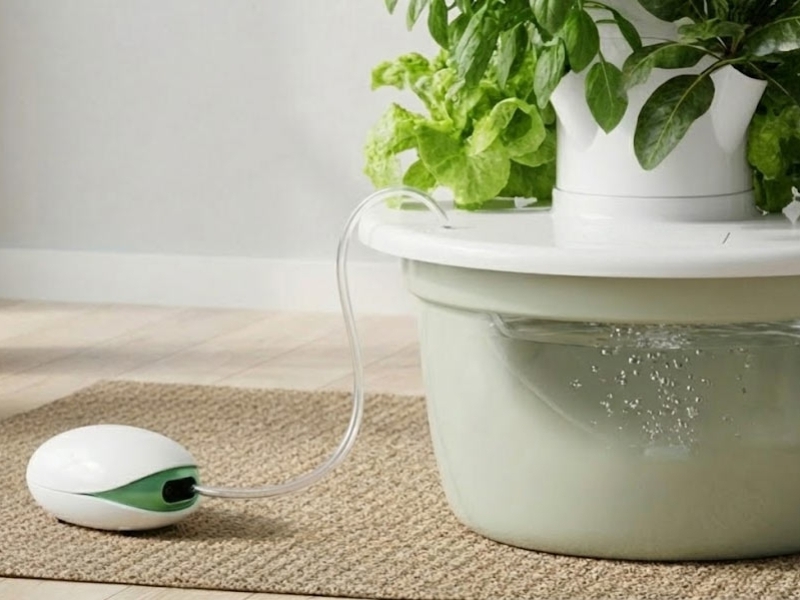
In advanced systems like those featured here, tanks and pumps are hidden within the base. The crucial detail for clean design is the concealment of water and electrical flows: the irrigation tube and corresponding cables are “hidden inside the totem’s structure.” This technique ensures essential “visual cleanliness,” preventing the clutter and dust buildup typical of systems with exposed wiring.
Materials, Hygiene, and Perceived Sustainability
The use of modern materials is not only functional but also reinforces aesthetic value. For example, the use of food-grade certified plastic for cultivation modules ensures water resistance and lightness while also conveying a commitment to environmental sustainability and consumer safety—values increasingly sought after by today’s buyers.
It is important to note that structural design oriented toward clean design has a dual aesthetic value: it ensures immediate visual cleanliness and easy maintenance over time. When technical components are encapsulated within totem structures, potential points of dirt and residue accumulation are reduced. A system that is easy to keep clean maintains its impeccable appearance longer—a crucial factor in luxury interiors.
V. Lighting: Functional Light Scenography for Domestic Habitats
Lighting is perhaps the most critical element in the aesthetic integration of an indoor hydroponic system, as it must meet strict biological requirements without chromatically polluting the domestic environment.
The Full Spectrum Solution: Goodbye Purple Light
Photosynthetic efficiency often requires intense light spectra, such as red and blue wavelengths, which produce the unpleasant and unaesthetic purple or pink hue often seen indoors.
The response from design-oriented manufacturers has been the widespread adoption of Full Spectrum LEDs. These systems are engineered to emit radiation covering the entire PAR range (400–700 nm) to maximize growth but are balanced to produce light perceived by the human eye as neutral or warm white. This allows the tower to blend seamlessly with the home’s standard ambient lighting.
Discreet Integration and Nighttime Scenography
The light source is incorporated into the structure itself, transforming it from a technical accessory into a design component. Integration typically occurs through slim LED bars embedded in the vertical frame that align with the cultivation modules. In some cases, additional lights (if needed, such as for plants requiring higher light intensity) can be further integrated, and the use of full-spectrum LED bars allows the grow technology to be incorporated into existing or adjacent furniture hosting the tower itself.
The tower’s illumination, active during the growth cycle, also serves as accent or mood lighting, merging its biological function with artistic expression.
VI. Summary of Key Points and Professional Validation
Market and architectural trend analysis unequivocally demonstrate that the domestic hydroponic tower has transcended its utilitarian origins, becoming fully recognized as a luxury furnishing element and a piece of sophisticated design. The success of systems such as Idroponica Facile’s towers—praised for their balance between functionality (high growth capacity) and aesthetic value—confirms that technical concealment and clean design solutions have been fully embraced and demanded by end consumers.
The following table summarizes the core design principles that legitimize the hydroponic tower as a living sculpture within the domestic environment.
Design Principles and Aesthetic Value of the Hydroponic Tower
| Design Principle | Objective in Interior Design | Manifestation in the Hydroponic Tower | |
| Biophilic Design | Transform the space into a dynamic and welcoming “natural refuge.” | Integration of lush greenery (hydroculture plants) and positive sensory stimulation. | |
| Focal Point | Create a visual anchor that dominates the space with grace and intent. | The vertical structure acts as a “functional sculpture” and visual contrast element. | |
| Clean Design / Concealment | Minimize visual clutter by hiding functional mechanisms. | Hide pumps, tanks, and wiring inside stainless-steel totems or tubular structures. | |
| Aesthetic Modularity | Ability to adapt the element’s size to the available space. | Assembly by cubes or columns to customize height and footprint, ensuring adaptability. | |
| Light Scenography | Use technical lighting to create a pleasant ambient atmosphere. | Use of full-spectrum LEDs (white light) to illuminate both the plants and surrounding space. |
VII. Conclusions and Invitation
Integrating a domestic hydroponic tower is a conscious choice that reflects adherence to the most advanced principles of contemporary architecture: sustainability, discreet functionality, and dynamic aesthetic impact. Through the rigorous application of biophilic design, the engineering concealment of technology, and the strategic use of full-spectrum lighting, these towers establish themselves as sculptural focal points, enhancing both the aesthetic value and the functional sophistication of the living space.
While analysis by architects and designers confirms the hydroponic tower’s unparalleled role as a furnishing object and style statement, it is crucial to remember that its impact extends beyond the visual realm alone.
We invite our readers to explore our in-depth analysis of the mental, human, and psycho-energetic benefits of having a home hydroponic garden by reading our dedicated article: [Link to the Psycho-Energetic Article].
Share this content